

1. Introduction
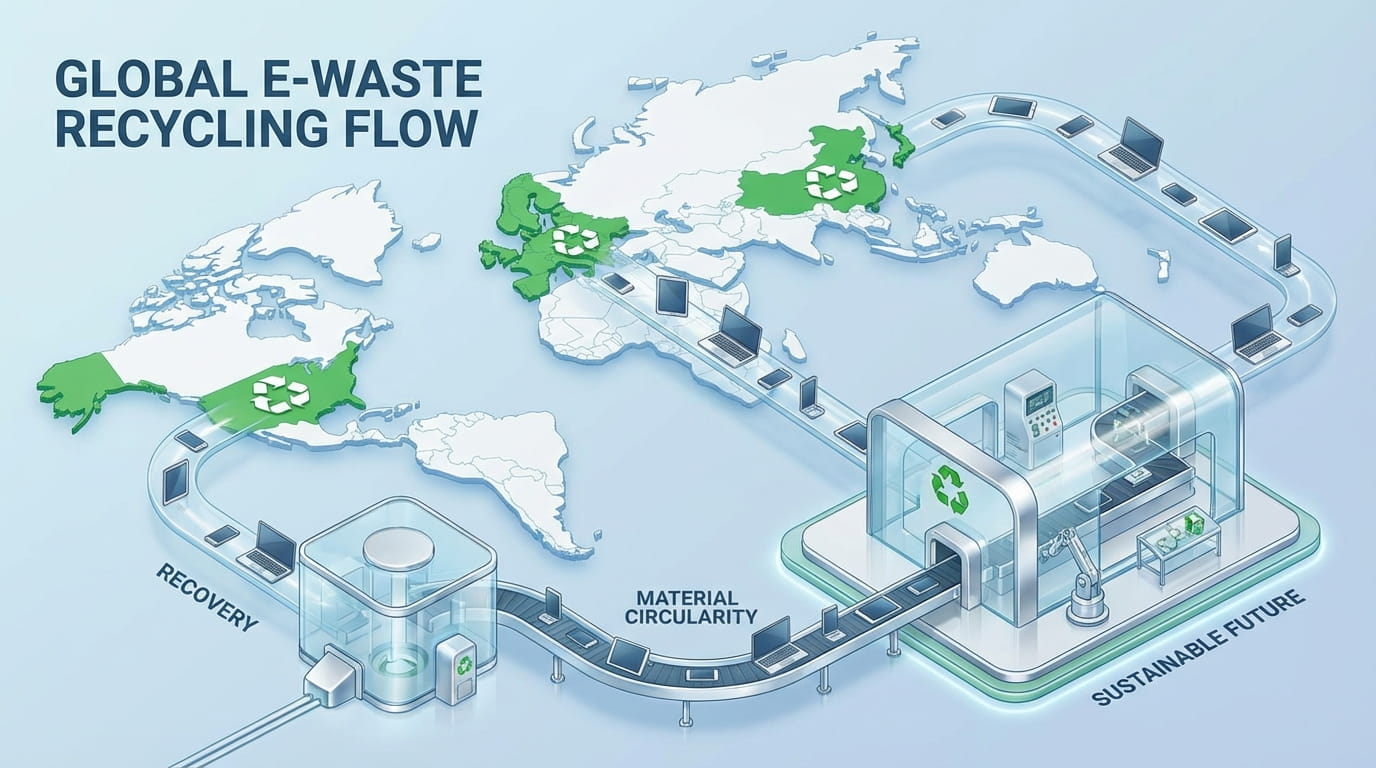
Developed countries generate some of the highest amounts of electronic waste due to high consumption of electronic products, rapid technological upgrades, and short product life cycles. To manage this growing waste stream, countries like the European Union, the United States, and Japan have developed structured legal, institutional, and technological systems. These systems focus on formal recycling, producer responsibility, consumer participation, and advanced infrastructure.
2. European Union (EU): A Centralized and Regulated Model
2.1 Legal Framework – WEEE Directive
The European Union manages e-waste primarily through the Waste Electrical and Electronic Equipment (WEEE) Directive. This directive applies uniformly across all EU member states and establishes clear rules for the collection, recycling, and recovery of e-waste.
Key objectives of the WEEE Directive:
- Prevent e-waste generation
- Promote reuse, recycling, and recovery
- Reduce the environmental and health impacts of hazardous substances
2.2 Extended Producer Responsibility (EPR)
Under the EU system, producers are legally responsible for financing and organizing the collection and treatment of e-waste generated from their products. Manufacturers must:
- Register in the national producer registers
- Report quantities of products placed on the market
- Pay fees to approved Producer Responsibility Organizations (PROs)
2.3 Consumer Collection System
- Consumers can return old electronics free of charge at collection centers and retail stores
- Retailers are obligated to accept small e-waste even without a new purchase
- Municipal collection points are widely available
2.4 Recycling Infrastructure
- Advanced, licensed recycling facilities
- Strict standards for depollution and material recovery
- High recovery rates for metals, plastics, and glass
2.5 Results and Impact
- One of the highest formal e-waste collection and recycling rates globally
- Strong compliance and enforcement mechanisms
- Reduced illegal dumping within EU borders
3. United States (USA): A Decentralized and State-Level Approach
3.1 Absence of a Federal E-Waste Law
Unlike the EU, the United States does not have a single national e-waste law. Instead, e-waste management is regulated at the state level.
3.2 State E-Waste Laws
- More than 25 states have implemented their own e-waste legislation
- Laws vary significantly between states
- Common focus on TVs, computers, monitors, and peripherals
3.3 Producer Responsibility Models
Two main models are used:
- Producer-Funded Model: Manufacturers finance recycling programs
- Advanced Recycling Fee (ARF): Consumers pay a small fee at the time of purchase
3.4 Role of Private Sector
- Strong participation of private recyclers and refurbishers
- Certification systems such as R2 and e-Stewards ensure responsible recycling
- Emphasis on data security and reuse
3.5 Challenges in the US System
- Lack of uniform national standards
- Uneven access to recycling programs across states
- Continued export of e-waste to developing countries
4. Japan: A Consumer-Responsibility and Recycling-Oriented Model
4.1 Home Appliance Recycling Law
Japan manages e-waste through the Home Appliance Recycling Law (HARL), which covers major household appliances such as:
- Televisions
- Refrigerators
- Washing machines
- Air conditioners
4.2 Shared Responsibility Model
Japan follows a unique shared-responsibility system:
- Consumers pay a recycling fee when disposing of appliances
- Retailers collect old products when delivering new ones
- Manufacturers operate and finance recycling plants
4.3 Advanced Recycling Technology
- Highly automated recycling facilities
- High material recovery efficiency
- Strong focus on resource extraction and purity
4.4 Cultural and Social Factors
- High public awareness and compliance
- Strong waste segregation culture
- Strict penalties for illegal dumping
4.5 Outcomes
- Very high collection and recycling rates for covered appliances
- Minimal informal recycling
- Efficient resource recovery system
5. Comparative Analysis
| Aspect | EU | USA | Japan |
|---|---|---|---|
| Legal Structure | Centralized (EU-wide) | State-level | National law |
| Producer Responsibility | Mandatory EPR | Partial / State-based | Mandatory |
| Consumer Role | Free take-back | Varies by state | Pays recycling fee |
| Recycling Infrastructure | Highly developed | Private-sector driven | Highly advanced |
| Informal Sector | Minimal | Minimal | Almost none |
6. Key Lessons from Developed Countries
- Strong laws and enforcement are essential
- Extended Producer Responsibility improves recycling outcomes
- Consumer participation increases collection rates
- Investment in technology leads to higher material recovery
- Transparency and reporting prevent illegal dumping
7. Conclusion
Developed countries manage e-waste through structured legal frameworks, formal recycling systems, and shared responsibility among producers, consumers, and governments. While approaches differ, the EU, the USA, and Japan demonstrate that effective e-waste management is possible when supported by strong policies, robust infrastructure, and widespread public awareness. These models offer valuable lessons for improving global e-waste governance.
(End of Document)
Leave a Reply